💎 October Birthstone Tourmaline vs Opal Which Fits You
🪨 What It Is
Tourmaline and opal are two captivating gemstones that share the spotlight as October's birthstones. Each of these stones is beloved for its unique qualities and stunning visual appeal. If you're interested in learning about these gems, expect to explore their appearance, properties, origins, value, and care.
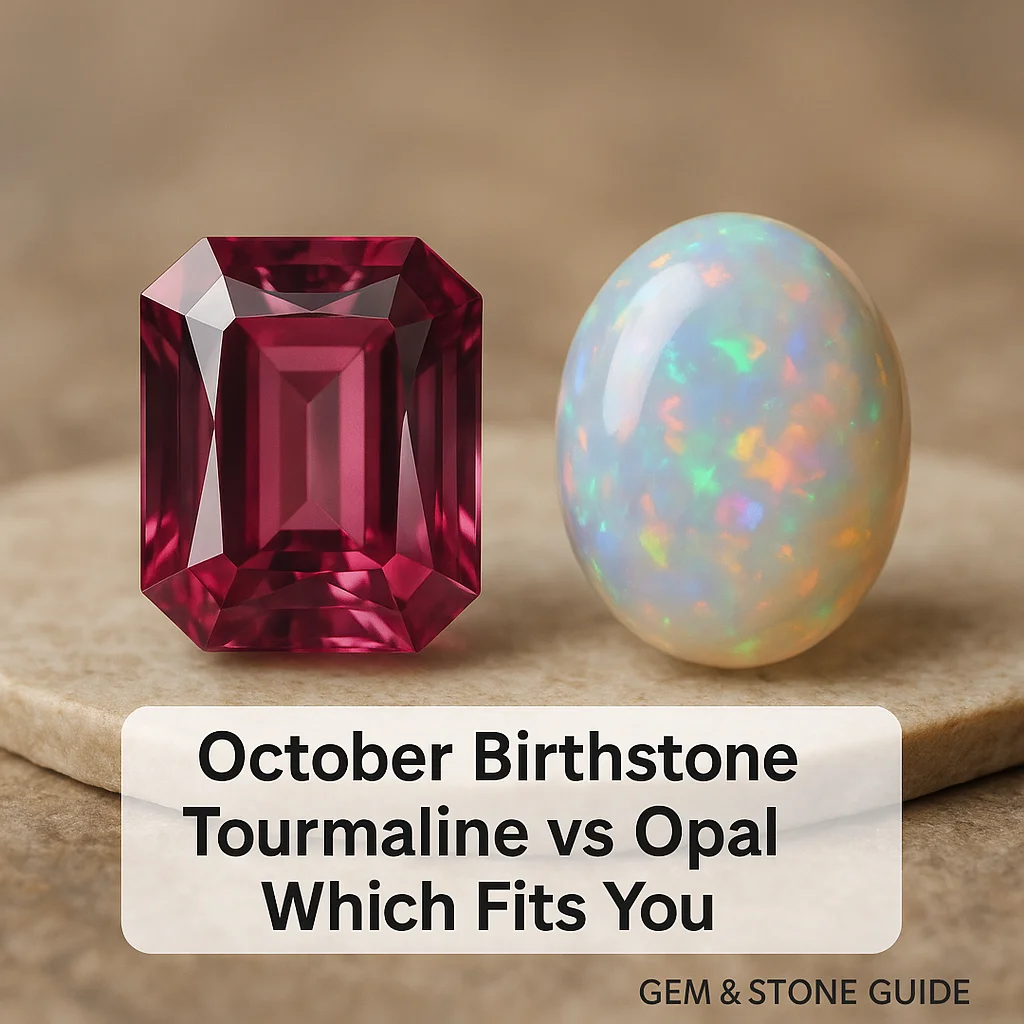
Tourmaline is known for its impressive range of colors, often found in vibrant shades such as green, pink, and blue. This variety is due to its complex borosilicate mineral structure. It's a popular choice for jewelry due to its durability and striking hues.
Opal, on the other hand, is celebrated for its mysterious play-of-color, a phenomenon where different colors seem to dance across the stone. This gem is primarily composed of hydrated silica and comes in various forms, such as precious opal and common opal.
🌍 Where It Comes From
Tourmaline forms in diverse geological environments, mainly within igneous and metamorphic rock settings. These conditions allow it to develop its signature colors through trace elements like iron, manganese, and lithium, which affect its appearance.
Major sources of tourmaline include Brazil, which is famous for producing a wide palette of colors, and parts of Africa, like Mozambique and Nigeria, where high-quality stones are found. The origin of a tourmaline can significantly impact its market value, often linked to its color saturation and clarity.
Opal originates mainly in sedimentary environments, where silica-rich waters seep into the ground and evaporate, leaving behind deposits of silica. It's commonly found in Australia, a leading producer known for its high-quality precious opals. Other notable sources include Mexico and Ethiopia.
🔬 How It Forms
Tourmaline's formation is attributed to the crystallization process occurring in the Earth's crust, typically under high pressure and temperature conditions. As minerals interact with hot, mineral-rich fluids, tourmalines form over millions of years.
The color of tourmaline is influenced by the presence of specific trace elements. For instance, iron and titanium can result in blue or green hues, while manganese is responsible for pink and red shades.
Opal forms as a result of water carrying silica through the Earth. This silica gradually hardens in rock crevices or cavities, creating opal over time. The play-of-color effect in precious opal arises from silica spheres diffracting light in various ways.
🎨 Color and Look
Tourmaline is renowned for its broad color spectrum, making it available in almost every shade imaginable. Some stones even feature bi-color or multi-color zones, such as the famous watermelon tourmaline, with a gradient of pink and green.
Opal's hallmark is its play-of-color, appearing as flashes of emerald green, fiery red, or deep blue, depending on the light and viewing angle. The base color of opal can be white, black, or any color in between.
Treatments such as heat and irradiation can enhance a tourmaline's color, while opals are rarely treated due to their unique structure.
🧪 Properties That Matter
Tourmaline ranks 7 to 7.5 on the Mohs hardness scale, making it suitable for most types of jewelry. It boasts a good toughness, meaning it resists chipping and breaking, with no cleavage planes.
Opal is softer, with a Mohs hardness of 5.5 to 6.5, making it more prone to scratches. Its brittleness requires careful handling and is better suited for less exposed jewelry pieces like pendants or earrings.
Both stones exhibit a vitreous to brilliant luster, enhancing their visual appeal when cut and polished to precision.
✨ Meanings, Birthstones, and Culture
Tourmaline is traditionally associated with creativity and balance. It is the modern choice for October's birthstone, celebrated for its variety and positive attributes.
Opal, as the traditional October birthstone, is often linked to inspiration and love. Its unique visual characteristics have inspired countless legends and cultural myths throughout history.
While these meanings are conventional, they represent cultural traditions rather than scientifically proven effects.
🧼 Care and Cleaning
To maintain tourmaline's beauty, use gentle soap and water with a soft cloth for cleaning. Avoid harsh chemicals and extreme temperature changes, which can cause damage.
Opal requires special care due to its porosity and softness. Clean opals gently with water and mild soap, avoiding soaking them too long and keeping them away from heat sources that could cause cracking.
Store both tourmaline and opal separately in soft pouches to prevent scratches or abrasions, especially opals, which are more delicate.
🛒 Buying Tips and What to Check
When buying tourmaline, key quality factors include its color intensity, clarity, and any visible inclusions. Origin can be a selling point, and larger carat sizes increase value.
For opals, evaluate the richness and pattern of the play-of-color. Precious opals with a black base tend to be more valuable. Demand disclosure about any treatments applied.
A lab report can provide clarity regarding a gemstone's authenticity and treatment status, an essential step for buying high-value stones.
⚠️ Real vs Fake and Common Look-Alikes
Tourmalines may be synthetic, created in labs but chemically identical to natural stones. However, glass and plastics often imitate tourmaline's vibrant colors, affecting authenticity perception.
Opals can be simulated by various imitations, including synthetics and assembled stones like doublets or triplets, which layer thin opal slices onto materials for a more affordable alternative.
Authentic identification requires professional evaluation, avoiding home-testing methods that could risk damage or misjudgment.
❓ Common Questions and Misconceptions
Is it a mineral or a rock? Tourmaline is a mineral; opal is a mineraloid.
Is it a birthstone? Yes, both tourmaline and opal are October birthstones.
Will it scratch easily? Tourmaline is relatively scratch-resistant; opal is softer and more prone to scratches.
Can it go in water? Briefly yes, but avoid long submersion, especially with opals.
Does color fade in sunlight? Prolonged exposure can fade opal; tourmaline is more stable.
What treatments are common? Tourmaline may be heated; opals are seldom treated.
Is lab-grown 'fake'? Lab-grown stones are real but not natural.
How do I store it safely? Store each separately, with opals needing extra care.
Do inclusions always lower value? Not always; some inclusions are accepted in certain stones.
How do I pick a good one for jewelry? Focus on color, clarity, and setting style.
📌 Summary
- Tourmaline and opal are October birthstones.
- Tourmaline exhibits a wide range of vibrant colors.
- Opal is known for its mesmerizing play-of-color.
- Formation involves complex geological processes.
- Tourmaline has good hardness; opal is softer.
- Treatments for tourmaline can include heating.
- Care involves gentle cleaning and careful storage.
- Necklaces and pins suit opals better; both suit rings and earrings if handled carefully.
- Glass and synthetics can imitate both stones.
- Lab reports help confirm authenticity.
- Birthstone symbolism ties into traditional meanings.
- Choose based on visual appeal and occasion.