💎 Rainbow Moonstone
🪨 What It Is
Rainbow Moonstone is a captivating gemstone that falls under the broader feldspar mineral group. It is a variety of the mineral labradorite and is renowned for its shimmering play of colors, referred to as adularescence. This unique effect gives the stone its "moonstone" name, evoking the visual imagery of a glowing moon.
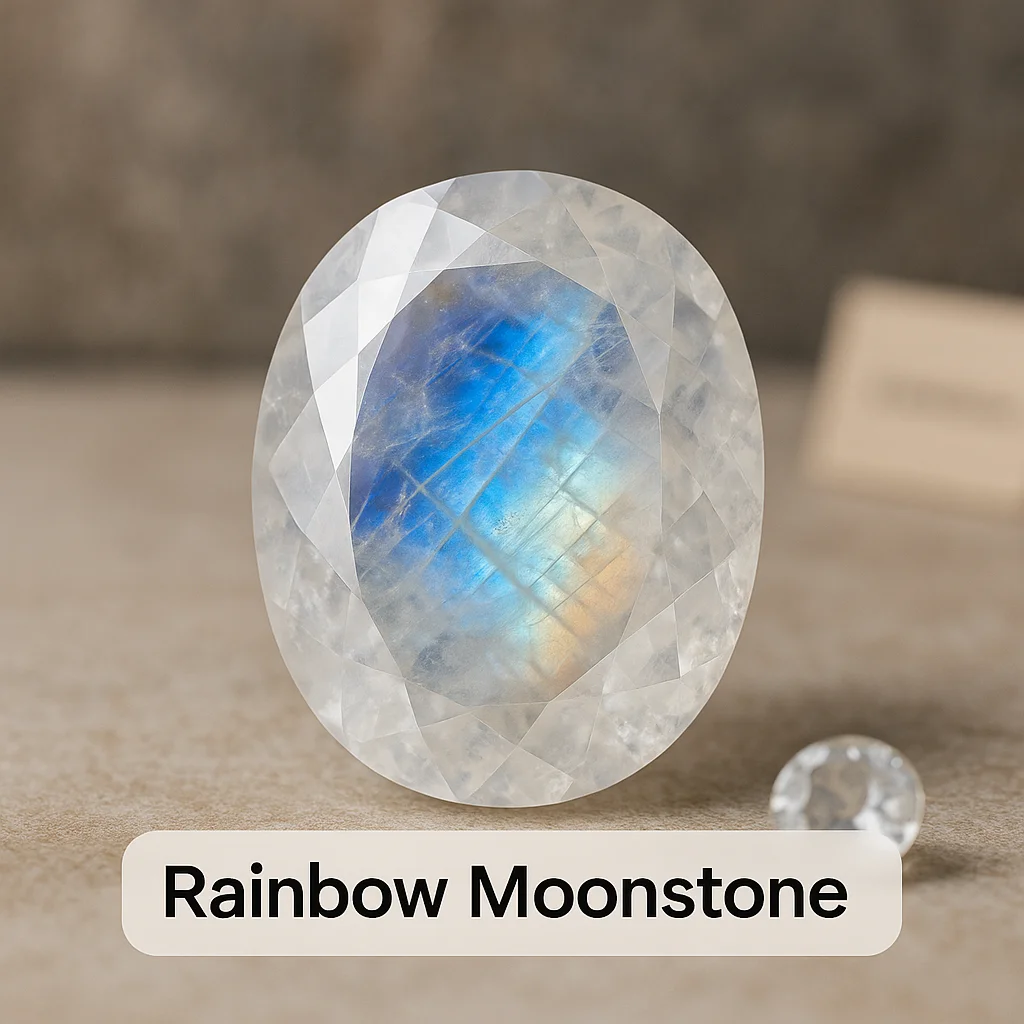
Commonly used in jewelry, Rainbow Moonstone is popular for its mystical appearance and is appreciated both by collectors and gem enthusiasts. While not a traditional birthstone, it is often associated with June, alongside its cousin, the mineral orthoclase moonstone.
In this article, you will learn about Rainbow Moonstone's appearance, properties, origins, value, care, and buying tips. We aim to provide beginner-friendly guidance for anyone fascinated by this enchanting gemstone.
🌍 Where It Comes From
Rainbow Moonstone can be found in a diverse range of geologic settings. These stones form primarily in igneous rocks, originating from cooled magmas rich in aluminum and potassium. Although they occasionally occur in metamorphic rocks, they are more commonly associated with igneous formations.
Some of the well-known regions for mining Rainbow Moonstone include parts of India and Madagascar. These areas are renowned for producing stones with striking color variations and a pronounced adularescent effect.
The origin of a Rainbow Moonstone can significantly influence its value due to differences in color, clarity, and the intensity of its adularescence. Stones from esteemed sources are often held in higher regard by collectors and jewelry designers.
🔬 How It Forms
Rainbow Moonstone forms through a process that involves high temperatures and pressures occurring over millions of years. As molten rock cools, minerals like feldspar crystallize, creating the potential for Rainbow Moonstone to develop in these environments.
Its colors and special effects are a result of internal structural features within the stone. The play of color, or adularescence, happens because of microscopic layers within the mineral, which scatter light and create a soft internal glow.
The characteristic lustrous sheen is dependent on the alignment and thickness of these layers, which influence the rainbow colors seen in Rainbow Moonstone. Trace elements and possible inclusions also contribute to its overall appearance.
🎨 Color and Look
Rainbow Moonstone is primarily recognized for its optic phenomenon called adularescence. This effect appears as a soft blue or multi-colored shimmer floating just beneath the stone's surface, reminiscent of moonlight across water.
When cut and polished properly, the stone may exhibit a range of colors including blue, green, orange, and even subtle purples and pinks. The intensity and type of color displayed depend greatly on the stone's quality and the skill of the cutter.
Though Rainbow Moonstone is often left untreated, beware of stones that might be improved artificially by methods like dyeing or coating. Such practices can sometimes enhance the appearance but may not be disclosed fully, affecting the stone's value and durability.
🧪 Properties That Matter
Rainbow Moonstone has a Mohs hardness of 6 to 6.5, which makes it moderately scratch-resistant but not as durable as sapphire or diamond. It is suitable for jewelry that receives gentle wear, such as earrings or pendants.
While the gem has a good toughness against breakage, it is prone to cleavage, meaning it can split along defined planes. Care must be taken to avoid impacts or stress that could cause chipping or fracture.
Its luster ranges from vitreous to pearly, contributing to its unique appearance. Due to its partial transparency, inclusions may be visible and could impact both aesthetics and value. Quality varies, and higher luster stones with minimal inclusions are often more desirable.
✨ Meanings, Birthstones, and Culture
Though Rainbow Moonstone itself is not a traditional birthstone, moonstone variations are often associated with June. In cultural traditions, Rainbow Moonstone has been linked to intuition, balance, and inspiration, although such associations are symbolic rather than scientific.
In modern jewelry customs, Rainbow Moonstone is appreciated for its mystical appeal and aesthetic versatility, making it a popular choice for bohemian or spiritual-inspired designs. Its unique look allows it to pair well with both silver and white gold settings.
Folklore surrounds Rainbow Moonstone with meanings of protection and love, often gifting the gem during new beginnings and personal milestones as a token of good fortune and well-wishes.
🧼 Care and Cleaning
The best way to clean Rainbow Moonstone is with warm, soapy water and a soft cloth. Avoid harsh chemicals and ultrasonic cleaners, which can damage this sensitive stone.
Due to its moderate hardness and potential for cleavage, make sure to handle Rainbow Moonstone with care. It is advisable to avoid extreme temperature changes and prolonged water exposure to preserve its natural beauty.
When storing Rainbow Moonstone jewelry, keep it in a separate compartment or pouch to prevent scratching from harder gemstones. This gentle care routine will ensure your stone maintains its charm over time.
🛒 Buying Tips and What to Check
Several factors affect the price and quality of Rainbow Moonstone, including color, clarity, cut, and carat size. Stones with clear adularescence, minimal inclusions, and a pleasing spectrum of colors generally fetch higher prices.
Inquiring about any treatments the gemstone might have undergone is essential, as honesty in disclosure can affect both value and care requirements. Requesting a lab report for high-value purchases can provide reassurance about authenticity.
For beginners buying online, check the quality of the seller’s photos, their return policy, and the reputation of the business. Clear disclosure and customer reviews can also guide a wise purchase.
⚠️ Real vs Fake and Common Look-Alikes
Understanding the difference between natural, synthetic, and imitation Rainbow Moonstone is crucial. Genuine Rainbow Moonstone can be distinguished by specific optical properties, while synthetics are lab-grown to mimic these traits.
Common imitations might include glass or plastic imitations, which lack the unique light effects of natural moonstone. Assembled stones like doublets or triplets are constructed from different materials and may also be mistaken as genuine.
Professional gemologists have the tools and expertise to accurately identify and authenticate Rainbow Moonstone, so always seek professional appraisal if authenticity is a concern.
❓ Common Questions and Misconceptions
Is it a mineral or a rock? Rainbow Moonstone is a mineral variety, specifically of labradorite.
Is it a birthstone? It is not a traditional birthstone, but it can be associated with June.
Will it scratch easily? With a hardness of 6 to 6.5, it is prone to scratching compared to harder stones.
Can it go in water? Brief exposure is fine, but prolonged immersion is best avoided.
Does color fade in sunlight? Generally, no, but it is wise to avoid extended UV exposure.
What treatments are common? Some stones are dyed or coated; ask before purchasing.
Is lab-grown 'fake'? Lab-grown means synthetic but not necessarily fake; it can share physical properties with natural stones.
How do I store it safely? Store separately in soft pouches to avoid scratches.
Do inclusions always lower value? Not always, but they can affect desirability and value.
How do I pick a good one for jewelry? Look for strong color, clear adularescence, and minimal inclusions.
📌 Summary
- Rainbow Moonstone is a variety of labradorite feldspar.
- Typically shows a range of colors with adularescence.
- Forms in igneous environments through crystallization.
- Moderate hardness and cleavage inform best uses as earrings or pendants.
- Commonly untreated; transparency impacts value.
- Careful cleaning with soap and water extends longevity.
- Best for jewelry pieces subject to gentle wear.
- Imitations include glass and assembled stones.
- Professional testing confirms authenticity.
- Consult a buying checklist for online purchases.
- Modernly symbolic, associated with balance and intuition.
- Remember, its enchanting glow makes it a cherished gem.